What Are the Early Signs That a Tree Is Dying? Insights From a Tree Care Contractor in Glenview, Illinois
Most trees do not go from healthy to dead in a week. They decline slowly, and this decline is visible through small changes that repeat over a season. Catching these changes early is safer and more affordable than waiting for a bad storm to finish the job.
Below, this tree care contractor in Glenview, Illinois is going to explain how the decline usually starts above ground, long before the final failure.
What are the first changes you can see in the canopy?
Branches that stop leafing out or stay thin.
Decline usually starts with a single branch that refuses to leaf out while the rest of the crown looks normal. The next season, that branch turns to deadwood. When the thin area covers the entire top instead of just one side, the problem is usually in the roots or the soil below.
Leaves that change color at the wrong time.
Another early sign is when leaves change color too early in the season. People say the tree is “showing fall early.” It is not. It is telling you it is in trouble. Drought, heat, compacted soil, root cuts from past construction, and disease are common triggers.
Deadwood or brittle branches.
A limb that snaps clean in your hand or feels hollow is a warning. If your fingers can break it, the wind can also break it.
New shoots on the trunk or at the base.
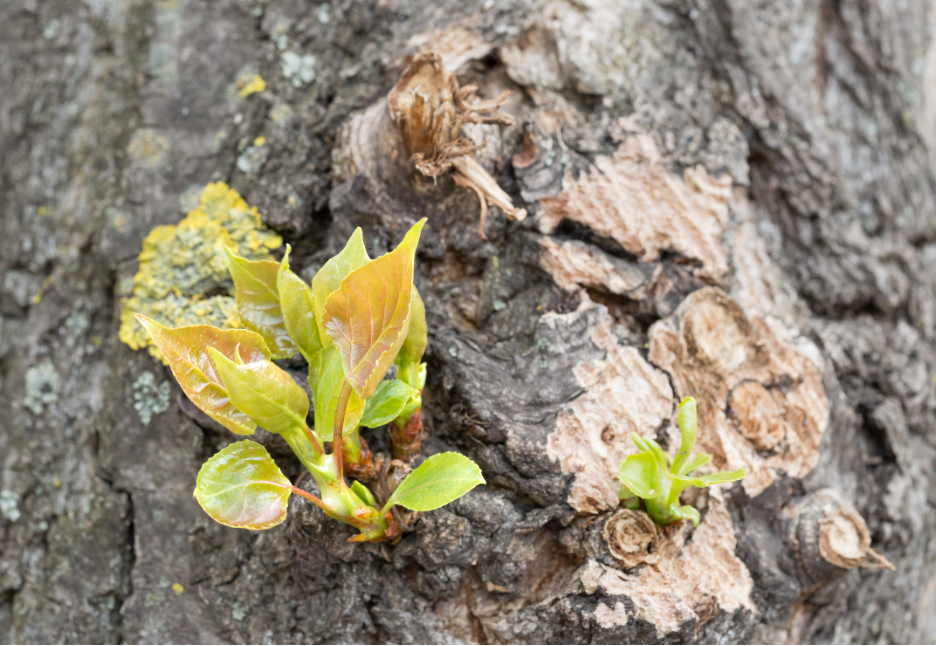
You may also see fresh shoots erupt from the trunk or base after a driveway, patio, or trench project. Those shoots are not a growth spurt. They are a stress response. Trees push those out when they think their root system is injured.
What should you watch for on the trunk and at the base?
Cracks or bark peeling away.
Once the trunk begins to change, decline is usually further along. Bark that splits or sheets of bark that peel back show the wood beneath is losing strength. A deep, clean vertical crack is the kind that fails in a storm. That kind of split does not self-repair.
Fungus or mushrooms at the base.
Mushrooms or conks at the base are not surface pests. They indicate that rot has already been working inside the wood column. Fungi do not fruit until decay is established. By the time you see them, the structural core is no longer sound.
Soil lifting or roots rising after storms.
Another red flag is soil movement after rain or wind. If the root plate lifts or if roots break the surface after a storm, the tree is working loose in the ground.
Does every warning sign mean the tree has to come down?
Some trees rebound with pruning or soil work. Others need cables or braces to keep them stable.
The key is knowing which trees can recover and which are past rescue. The real call depends on what is happening under the bark and under the soil. This is why any professional tree care contractor in Glenview, Illinois will diagnose risk before recommending any cut.
What does a tree contractor check during an inspection?
A professional tree care contractor in Glenview, Illinois will check the crown for dieback, the trunk for cracks and seams, the base for fungus and lift and the soil for compaction or grade changes from past work. The goal is to define risk. Once the risk is clear, the path forward (prune, cable, treat the soil, or remove the tree entirely) becomes clear as well.
When is it time to actually call a professional?
Do not wait if the tree leans after a storm, mushrooms show at the base, the trunk cracks or a large dead limb hangs above a driveway or roof. Delaying can turn a fixable problem into an expensive one, and sometimes into a 911 call.
Looking for a tree care contractor in Glenview, Illinois?
Are you worried about a sick tree on your property? If so, and if you are ready to work with the best tree care contractor in Glenview, Illinois, look no further than Brown Tree Service, Inc. Our team of ISA Certified Arborists can inspect your trees and lay out the next steps based on actual risk.
If the tree can be saved, we will tell you how. If it cannot, we can remove it before weather or gravity makes that decision for you. Contact us today to schedule your consultation.